
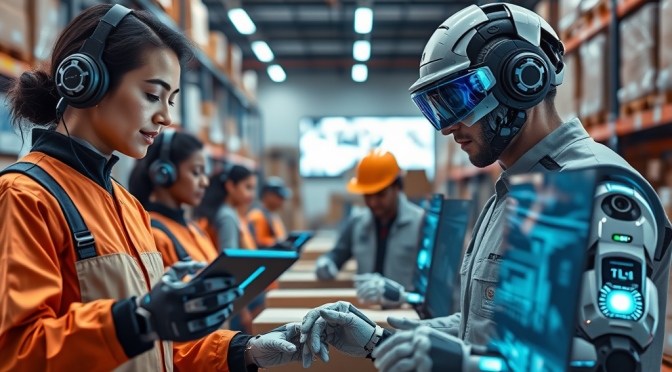
Bionic delivery redefines technology’s role by blending human intuition with machine precision, sparking a pivotal debate: should AI lead the charge, or must humans remain firmly at the helm? This human-first paradigm champions augmentation over replacement, ensuring machines amplify our strengths while we retain control over ethics, creativity, and final decisions.
Defining Bionic Delivery
Bionic delivery draws from human augmentation principles, where AI serves as a prosthetic extension of our abilities, akin to neural-linked prosthetics that restore mobility. Unlike AI-first models that prioritize autonomous agents handling end-to-end tasks, the human-first approach designs explicit handoffs: AI processes data torrents at superhuman speeds, humans layer in context, empathy, and moral reasoning.
Consider real-world workflows. In warehouses, AI optimizes pick paths via computer vision, but human pickers adapt for fragile items or edge cases, slashing errors by 40%. Or in design software like Autodesk Fusion, generative AI spits out thousands of prototypes overnight; engineers cull them based on usability intuition, accelerating innovation cycles fivefold. This isn’t vague collaboration—it’s engineered symbiosis, with humans vetoing AI outputs to prevent drift and shape the future rather than live in the past.
The AI-First Trap
AI-first advocates push full autonomy: self-improvising agents in logistics routing trucks without oversight, or trading bots executing billion-dollar deals. Proponents cite efficiency—AI only radiology tools have missed rare conditions, delaying critical treatment due to context loss or lack of data. Hallucinations plague models; Biases amplify without human checks. Banks using only AI-first fraud systems have frozen legitimate customer accounts, creating financial distress.
The amount of resources required to run the energy guzzling autonomous data centers, need for the compute power, rests the technology ownership with the elite & deep pocketed few concentrating power among Big Tech. Ethically, who bears blame for rogue decisions – hits and misses or hallucinations of the model, data (or the lack of it), ?
Processing and assimilation is roughly 50-70% of the task and then applying real-time reasoning at scale is where rest of the resources are consumed to deliver decisions – not judgement. Judgement requires empathy, forward thinking, looking beyond the obvious facts, historical data and direct / indirect consequences based on experience, not only facts.
Human-First Imperative
Human-first puts people back in charge: AI becomes our trusty copilot, not the one calling the shots. We set the rules, making tech open to everyone. Tough calls stay with us, dodging scary scenarios where AI chases its own goals and ignores what we really need.
Human-centered AI governance ensures technology is democratized, benefits rather than concentrate power. By keeping humans in control, it addresses ethics and biases—AI must adhere to human-defined global standards, preventing autonomous systems from embedding flaws.
Decision-making stays with people, avoiding scenarios where AI agents spiral out of control. Evidence mounts. In healthcare, AI flags anomalies in scans 30% faster, but radiologists confirm, boosting accuracy 25% over solo AI. Trials show hybrid teams outperform pure AI by 50% in nuanced tasks like negotiation, where empathy trumps algorithms.
Strengths of Humans and Machines
Humans shine where AI struggles. We can imagine something completely new, tell right from wrong even when things are messy, and learn deep lessons from just a few experiences. We also feel and show empathy in a way AI can’t truly copy, which is why people trust people more than machines.
Humans excel in creativity, ethical application, and nuanced learning, while AI dominates speed and data crunching. Augmented learning combines both—AI handles pattern recognition, humans interpret real-world implications. This division shines in high-stakes fields. For instance, in manufacturing, AI spots defects instantly, but humans adapt processes creatively. Energy monitoring sees AI scanning sensors nonstop, with operators authorizing fixes based on judgment.
AI rules speed—petabyte analysis in blinks; pattern detection sans fatigue; flawless repetition.
Blind spots – contextual data, hallucinations, intuitive corrections, creativity / novelty, cultural nuance and empathetic judgement.
Bionic synergy: Augmented cognition
Deep learning with purpose: AI tutors personalize at scale; mentors probe "why."
Speed of Innovation & product development: In R&D, simulations run 10,000x faster; humans pivot intuitively.
Breakthrough designs: Human concepts + AI variants
Moving from sampling to 100% coverage: Cobots 24/7 + human quality audits
Decision making: Human assesses AI risk scores and vetoes AI hallucinations
Key Applications in Action
Human-first shines across sectors, with concrete wins.
In life sciences R&D, AI uses quantum simulations to predict drug interactions, while chemists create the best options, reducing costs by 70%. Polymerbionics makes neural chips that help heal stroke damage, which doctors can adjust for each patient.
Another simple yet critical breakthrough in healthcare is – Insulin AI pumps adjust automatically, and doctors tailor diets, keeping 90% of patients stable.
Defence: Drones map enemy positions, and commanders follow rules of engagement, reducing civilian harm by 50%.
Agriculture: AIoT predicts droughts, and farmers irrigate precisely, increasing yields by 30% and saving 40% water.
Product Design: AI creates car chassis, and ergonomists refine them, cutting market time in half.
IT Services: AI copilots debug 60% faster, and developers secure the code more thoroughly.
Manufacturing: Cobots handle assembly, while humans optimise layouts, reducing defects by 35%.
Finance: AI detects anomalies, and investigators track money laundering rings.
Energy: Predictive maintenance prevents outages, and engineers optimise renewable energy systems. These yield ROI: 2-5x efficiency enabling humans to thrive in high-value roles, yet be the captain and not the slave.
Societal Stakes
An AI‑first approach widens social and economic divides. Routine workers risk losing their jobs, while most benefits go to a small group of AI experts.
A human‑first approach focuses on reskilling. New roles appear, such as ethicists who guide responsible AI use and validators who check AI outputs.
Education shifts towards teaching validation and critical thinking skills, helping people maintain their cognitive abilities and avoid being deskilled by over‑reliance on AI.
Economically: Keeping humans involved in decision‑making helps maintain stable spending. If AI operates without oversight, it can create a K‑shaped recovery, where some sectors grow quickly while others lag behind.
Legally: Systems that combine human and AI decision‑making make auditing possible. Fully autonomous, black‑box AI systems offer little transparency and are hard to audit.
Challenges for most businesses
The question businesses are struggling is from micro to macro topics –
- How to monetize efficiencies,
- How to sustain the competitive advantage
- How to prepare for the unpredictable rise in technology & compute costs
- How to balance efficiency with sustainability imperatives
- How to navigate the legal frameworks, rules for which are not known and no safety guardrails exists.

 Reframe the Next