
How GCCs Safeguard Stakeholder Interests

In today’s global landscape, volatility is the new normal. From sudden trade disputes and new tariffs to regional conflicts and political instability, the currents of geopolitics are turbulent and unpredictable. For multinational corporations, these tensions are not distant headlines; they are direct threats to operations, supply chains, and, ultimately, stakeholder value.
In this challenging environment, organizations are realizing that their Global Capability Centers (GCCs) have evolved far beyond their traditional role as cost-optimization hubs. They have become strategic nerve centers, essential for navigating uncertainty and building enterprise-wide resilience. A smart, diversified GCC strategy is no longer just about efficiency—it’s a critical tool for insulating an organization from geopolitical shocks.
The GCC as a Strategic Insulator
At their core, GCCs provide business continuity by centralizing critical functions—such as IT, finance, human resources, and supply chain management—in locations separate from corporate headquarters. This geographic and operational separation creates a powerful buffer.
When a crisis hits a primary region, whether it’s a natural disaster, a political shutdown, or a public health emergency, a well-established GCC can maintain essential services. This ensures the global “engine” of the business keeps running. This operational resilience is the first line of defense in safeguarding stakeholder interests. Customers continue to receive service, employees in other regions remain supported, and investors see a stable, well-managed operation capable of weathering a storm.
Diversification: The Ultimate De-Risking Strategy
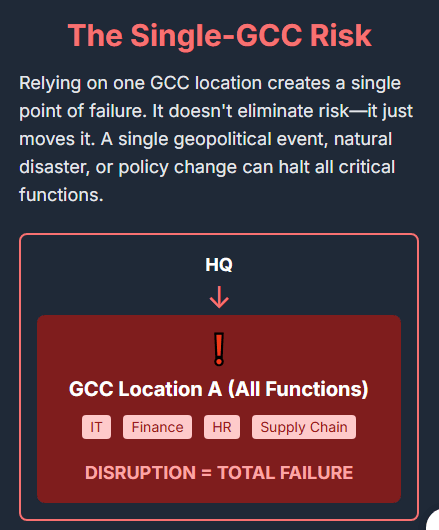
The real strategic power, however, is unlocked not by a single GCC, but by a diversified portfolio of them. Relying on one large GCC in a single country simply shifts the concentration risk from one location to another. A truly resilient “multi-shore” strategy involves spreading critical capabilities across multiple, geographically distinct, and politically stable regions.
Imagine an organization with key functions distributed across specialized centers in South Asia, Eastern Europe, and Latin America. This diversification creates a redundant and flexible network. If geopolitical tensions flare up in one host country, leading to new regulations or operational hurdles, the other centers in the network can seamlessly absorb the critical workload. This “don’t put all your eggs in one basket” approach moves the organization from a reactive to a proactive risk posture, minimizing disruptions before they can impact the wider business.
Mastering Trade Flows Through a Diversified Network
This diversified strategy is particularly powerful for managing one of the most vulnerable areas of modern business: global trade flows and supply chains.
GCCs have evolved to become the “control towers” for their organizations’ global logistics. They use advanced analytics, AI, and real-time data to monitor supplier performance, track shipments, and manage procurement. When a diversified GCC network is applied to this function, it becomes a formidable tool for navigating trade disruptions.
- Providing Localized Insights
- Supporting Tariff Engineering
- Leveraging Free Trade Agreements (FTAs)
- Identifying Trade Alternatives
The New Strategic Imperative
In an era defined by uncertainty, a well-designed, diversified GCC strategy is no longer optional. It has become a core component of corporate strategy. By building a resilient, multi-shore network of capabilities, organizations can do more than just survive geopolitical turbulence—they can navigate it smartly, protecting their operations, mastering their supply chains, and delivering on their ultimate promise to safeguard stakeholder interests.
The strategic imperative for organizations today is not whether to establish a GCC, but rather how to fully leverage these centers for maximum strategic impact. As the global business landscape continues to be defined by uncertainty, GCCs stand as critical enablers of innovation, competitiveness, and long-term growth. They empower organizations to transform challenges into opportunities, ensuring sustained success in an increasingly fractured global economy
 Reframe the Next